VexcoltVexcolt
+44 (0)2081945999
  • LinkedIn
  • Instagram
  • WhatsApp
×
  • ABOUT
  • NEWS
    • FAQ
    • Glossary
  • PRODUCTS
    • MicrAtec Overview
    • MaxAtec Overview
    • MegAtec Overview
    • SeismAtec Overview
    • TransAtec Overview
    • FlexAtec Overview
    • ElastAtec Overview
    • AquAtec Overview
    • AquaFlex Overview
    • FireFlex Overview
    • IsolAtec Overview
    • Intersections Overview
    • Price/sample request
  • OUR WORK
    • PROJECTS
    • CASE STUDIES
  • APPLICATIONS
    • Airports
    • Car Parks
    • Factories
    • Hospitals
    • Offices
    • Rail
    • Shopping Centres
    • Stadiums
  • NETWORK
    • UK Network
    • International Network
  • BESPOKE SERVICE
  • CONTACT
Vexcolt
  • ABOUT
  • NEWS
    • FAQ
    • Glossary
  • PRODUCTS
    • MicrAtec Overview
    • MaxAtec Overview
    • MegAtec Overview
    • SeismAtec Overview
    • TransAtec Overview
    • FlexAtec Overview
    • ElastAtec Overview
    • AquAtec Overview
    • AquaFlex Overview
    • FireFlex Overview
    • IsolAtec Overview
    • Intersections Overview
    • Price/sample request
  • OUR WORK
    • PROJECTS
    • CASE STUDIES
  • APPLICATIONS
    • Airports
    • Car Parks
    • Factories
    • Hospitals
    • Offices
    • Rail
    • Shopping Centres
    • Stadiums
  • NETWORK
    • UK Network
    • International Network
  • BESPOKE SERVICE
  • CONTACT
  1. Home
  2. Blog
  3. Technical Introduction
  4. Expansion Joints

Expansion Joints

in Technical Introduction

Creep compounded by column shortening can cause problems for a number of trades which follow the structural contractors.

Relative vertical deflection due to creep and column shortening

Creep compounded by column shortening can cause problems for a number of trades which follow the structural contractors. Many contractors for instance are more concerned about the relative deflection of adjacent floors rather than their absolute height above datum.

Creep deflections can be predicted with a fair degree of accuracy however column shortening is less easily dealt with. Like creep, column shortening varies with time, not only due to creep but also because the load increases gradually as extra floors are built, fitted out and handed over. Once again uniformity in plan is important as column size at each location and level should be matched fairly closely to the actual permanent load whereby the long-term shortening of each column should be broadly similar.
Lateral deflections

Lateral deflections are caused by the drying shrinkage of building components, thermal expansion and contraction due to temperature cycling and sway caused by wind loading. Movement due to shrinkage and temperature should be broadly similar at all levels within the structure, but lateral movement due to wind loading increases with height above ground.

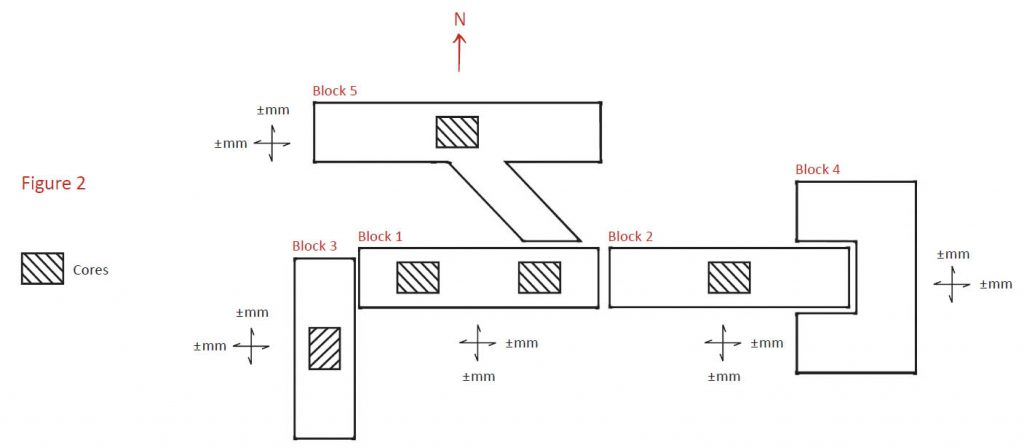
Cores within independently constructed units form effective anchors for determining and limiting lateral movement. This is illustrated in Figure 2 where the cores of each multi-storey block are centrally located and form an effective anchor for determining shrinkage and temperature movements. Block 1 is very stiff owing to the presence of two main cores and this restraint reduces the relative movement between it and the link-bridge. Block 4 as a single storey structure does not require a core.

The total horizontal movement at any point is determined by summing the long-term shrinkage, the temperature variation and the wind movement at each level of each block interface.

Where are expansion joint located?

One of the key elements in successfully locating expansion joints is plan uniformity. As Eurocode 8: EN 1998-1-2004 ‘Design of structures for earthquake resistance’ states: ‘Uniformity in plan is characterised by an even distribution  of the structural elements which allows short and direct transmission of the inertia forces created in the distributed masses of the building. If necessary, uniformity may be realised by subdividing the entire building by [seismic] joints into dynamically independent units.’

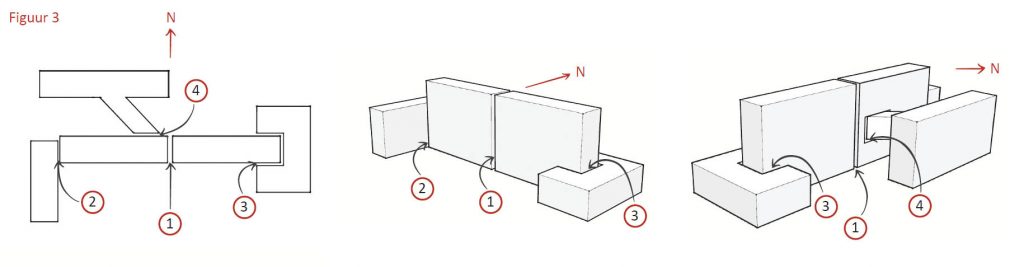
Figure 3 mirrors Figure 2 and shows the layout of a series of such dynamically independent units separated by expansion joints.

Expansion joint 1 subdivides the main building into two independent units. Such joints typically arise at 30 to 50 metre centres.

Expansion joint 2 lies between the main building and an adjoining multi-storey annex. This joint lies at a point where there is a change in direction between the two elements. An expansion joint may be required due to a number of factors including differential wind loading and the possibility that the structures were built at different times.

Expansion joint 3 divides the main high-rise structure from a lower height building and again differential wind loading and the possibility that the structures were built at different times may be factors in determining the location of this expansion joint.

Expansion joint 4 arises between a link-bridge joining the main building to an outlying structure. This expansion joint allows the link-bridge to accommodate movement from temperature variation and wind loading which will cause it to oscillate to and fro about a mean position.
 

Installing fire barriers beneath expansion joints
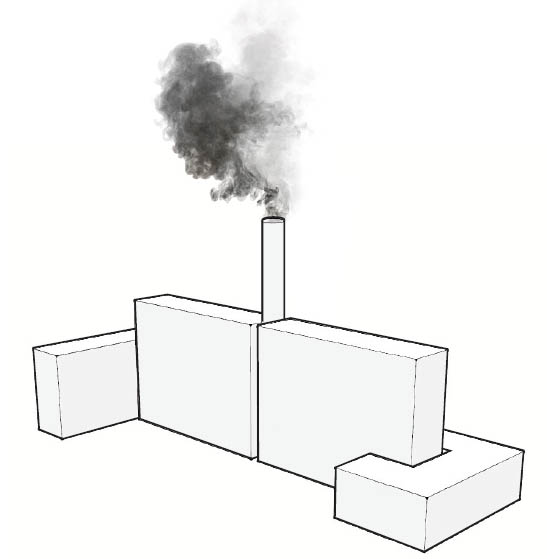
It may seem strange to install fire barriers beneath expansion joints until one considers that in the event of fire they act as chimneys funnelling toxic smoke and flames through the building and often through fire compartment walls.

Using mineral wool as a fire barrier in expansion gaps

In some instances a designer may specify mineral wool as the fire barrier in an expansion gap. However mineral wool will compress when the expansion gap closes but will not expand when it opens. As a result toxic smoke and flame bypass the mineral wool infill and pass through compartment walls.

It is prudent to install fire barriers with a matching rated movement capacity beneath expansion joints that pass through compartment walls.

April 23, 2019
SHARE
  • Email
  • X
  • Facebook
  • Pinterest
  • Linkedin
  • Vkontakte
  • WhatsApp

Leave a Reply Cancel reply

Your email address will not be published. Required fields are marked *

  • 3 × two =

Categories
  • Animations
  • News
  • Product Information
  • Technical Introduction
Popular
Celebrating 40 Years November 7, 2025
Causes of Movement June 27, 2017
Traffic Frequency June 27, 2017
Traffic Types June 27, 2017
Tags
Accessibility Animation ElastAtec Eurocodes Fireproofing IsolAtec MaxAtec 100 Movement sample Technical Introduction Traffic Frequency Waterproofing
Stay updated

Error: Contact form not found.


Head office: +44 (0) 208 194 5999
Northern office: +44 (0) 161 543 9898

Sales email: info@vexcolt.com
Technical email: technical@vexcolt.com

Social Media
  • LinkedIn
  • Instagram
  • WhatsApp
Projects
  • Airports
  • Department Stores
  • Educational
  • Entertainment Venues
  • Hospitals
  • Museums
  • Offices & Hotels
  • Places of Worship
  • Residential
  • Sports Stadiums
  • Train Stations
Latest News
July 9, 2026 Introducing the SeismAtec 427-A07-A09
July 9, 2026 Introducing the FlexAtec 1000-A07-A09
July 9, 2026 Introducing the FireFlex 2300 and 2700 Series
July 8, 2026 Introducing the AquaFlex 1600-A01-A02
June 24, 2026 Now Available: Request a Vexcolt Product Sample Online
Copyright © Vexcolt Ltd
  • Privacy Policy & Cookies
    We use cookies on our website to give you the most relevant experience by remembering your preferences and repeat visits. By clicking “Accept All”, you consent to the use of ALL the cookies. However, you may visit "Cookie Settings" to provide a controlled consent.
    Cookie SettingsAccept All
    Manage consent

    Privacy Overview

    This website uses cookies to improve your experience while you navigate through the website. Out of these, the cookies that are categorized as necessary are stored on your browser as they are essential for the working of basic functionalities of the website. We also use third-party cookies that help us analyze and understand how you use this website. These cookies will be stored in your browser only with your consent. You also have the option to opt-out of these cookies. But opting out of some of these cookies may affect your browsing experience.
    Necessary
    Always Enabled
    Necessary cookies are absolutely essential for the website to function properly. These cookies ensure basic functionalities and security features of the website, anonymously.
    CookieDurationDescription
    cookielawinfo-checkbox-analytics11 monthsThis cookie is set by GDPR Cookie Consent plugin. The cookie is used to store the user consent for the cookies in the category "Analytics".
    cookielawinfo-checkbox-functional11 monthsThe cookie is set by GDPR cookie consent to record the user consent for the cookies in the category "Functional".
    cookielawinfo-checkbox-necessary11 monthsThis cookie is set by GDPR Cookie Consent plugin. The cookies is used to store the user consent for the cookies in the category "Necessary".
    cookielawinfo-checkbox-others11 monthsThis cookie is set by GDPR Cookie Consent plugin. The cookie is used to store the user consent for the cookies in the category "Other.
    cookielawinfo-checkbox-performance11 monthsThis cookie is set by GDPR Cookie Consent plugin. The cookie is used to store the user consent for the cookies in the category "Performance".
    viewed_cookie_policy11 monthsThe cookie is set by the GDPR Cookie Consent plugin and is used to store whether or not user has consented to the use of cookies. It does not store any personal data.
    Functional
    Functional cookies help to perform certain functionalities like sharing the content of the website on social media platforms, collect feedbacks, and other third-party features.
    Performance
    Performance cookies are used to understand and analyze the key performance indexes of the website which helps in delivering a better user experience for the visitors.
    Analytics
    Analytical cookies are used to understand how visitors interact with the website. These cookies help provide information on metrics the number of visitors, bounce rate, traffic source, etc.
    Advertisement
    Advertisement cookies are used to provide visitors with relevant ads and marketing campaigns. These cookies track visitors across websites and collect information to provide customized ads.
    Others
    Other uncategorized cookies are those that are being analyzed and have not been classified into a category as yet.
    SAVE & ACCEPT
    • LinkedIn
    • Instagram
    • WhatsApp
    Cart